
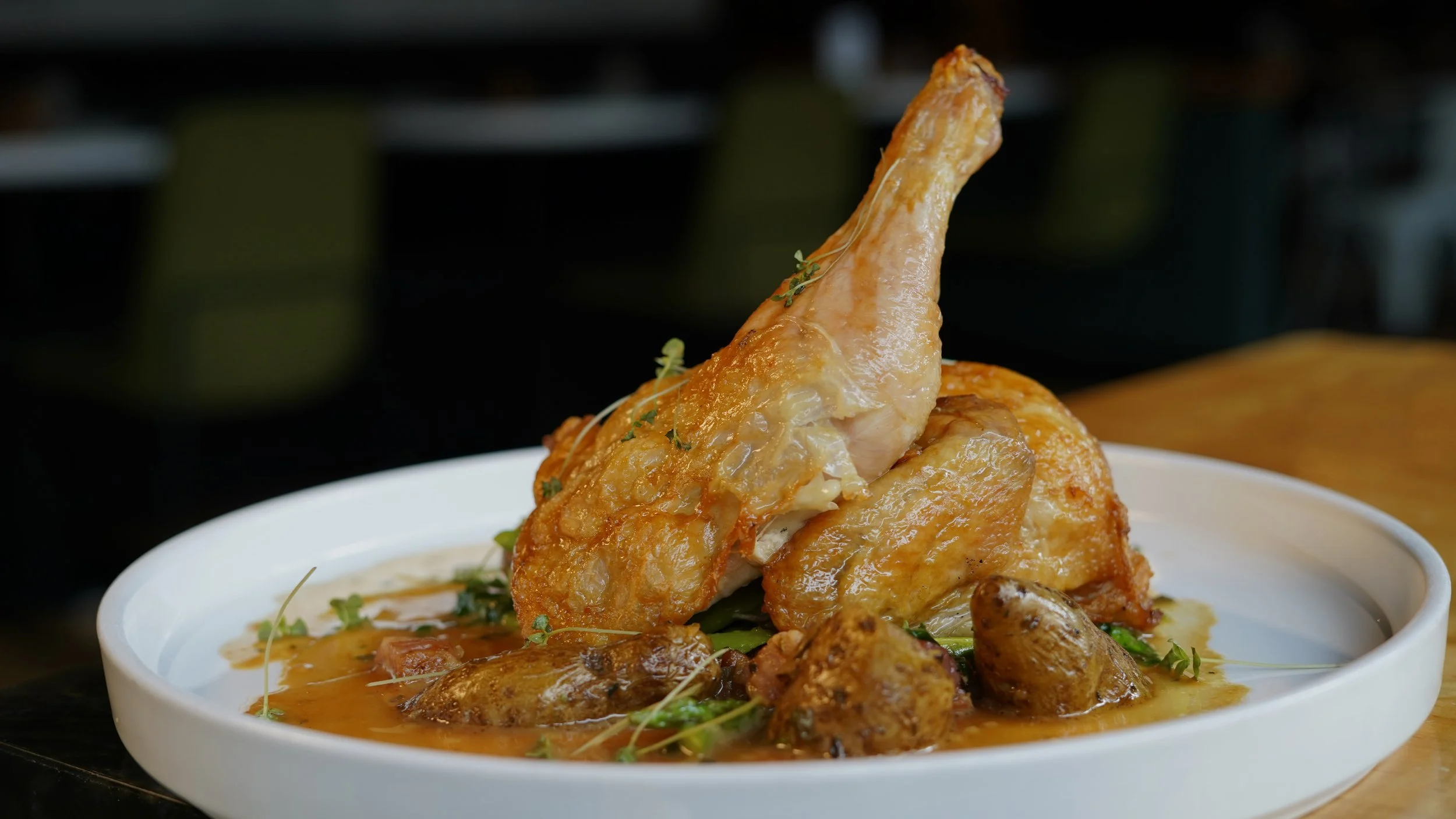
Cooking is a craft before it is an art. The skills come first, knife work, heat control, timing, repetition, and the artistry grows out of mastering them, not the other way around. A chef who can't execute can't express their vision properly. The plate is where both things are tested at once: the craft in the technique, the artistry in the decisions.
At Per Diem, composed plating isn't a stylistic affectation. It's a discipline. The kitchen's menu pulls from a wide range of culinary traditions, and that breadth creates a real problem: without structure, a plate full of influences reads as confusion. Composed plating is how the kitchen solves that problem. Every element has an assigned position, and that position has a reason.
The visual logic comes second. It looks intentional because it is, but intention, here, means flavor first, always. The sauce isn't placed for contrast; it's placed where it will be encountered at the right moment in the bite. The garnish isn't decoration; it's punctuation. A leaf of herb or a scattering of seed is telling you what the kitchen thinks this dish is about. Which means it has to be right.
Here's what that actually looks like in practice. Sauce goes on the bottom, not for the look of it, but because anything fried or roasted that sits in pooled liquid loses its crust within minutes. Texture is the next decision: something crunchy against something silky, something acidic against something rich. A melt-in-your-mouth braise needs a foil, crispy vegetables, toasted breadcrumbs, something pickled, or the whole plate reads as one note. Fat, acid, and seasoning get balanced at plating, not just in the pan, because the dish is still being built. And then there's negative space: the empty plate around the food isn't laziness. It's focus. It tells the eye where to go before the fork follows.
This is the part that takes training to see. The instinct is to read a composed plate the way you'd read a painting, as image. But a composed plate is really a sequence. It has a beginning, a middle, and a conclusion, and the chef has to think about all three before any of it lands in front of you.
Think about it from the other direction: the guest picks up a fork without instructions. They'll move through the plate in whatever order feels natural, toward the protein first, or the sauce, or whatever catches the eye. A composed plate anticipates that. It creates a center of gravity that draws the fork where the kitchen wants it to go, and then rewards the guest for going there. That's not manipulation. That's hospitality expressed through statistics and probability.
That discipline, the insistence on visual logic that is also flavor logic, is what separates composed plating from garnished plating. One is craft. The other is habit.
-Paul
